Gourmet
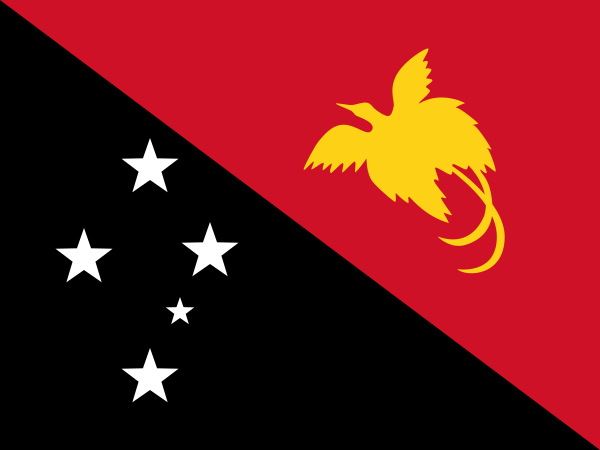
Papua New Guinea
Papua New Guinea has been a coffee growing country since the late 19th century when the British first introduced it. Today, Papua New Guinea accounts for 1% of the world's coffee production, 95% of which is Arabica, which is favoured by the highland terrain of this country. Small farms grow more than 90% of coffee in this country, with more than two million people dependent on it for their livelihood. The coffee in this country is grown in volcanic soil, which provides the nutrients for the distinct tasting coffee to grow. The altitude ranges from 1300-1900 meters above sea level and the two main regions for coffee growth are the Western Highlands and the Eastern Highlands, where 75% of coffee production occurs.
From Papua New Guinea right now
2
coffees on the current offer list
Filter the list to Papua New GuineaGrowing Papua New Guinea
Reference notes on the crop itself. Lot-level detail is confirmed with the desk coffee by coffee.
- Harvest
- Peak May, June and July, with enough cherry ripening to extend the season from March to October through what is known as fly pickings
- Altitude
- Roughly 1,300 to 1,900 m. The Coffee Industry Corporation rates 1,300 to 1,699 m as most suitable and 1,100 to 1,899 m as the wider suitable band; most smallholder arabica sits above 1,500 m.
- Varietals
- Blue Mountain (Coffea arabica var. typica), Bourbon, Arusha, Caturra Red, Mundo Novo and Catimor
- Processing
- Wet process (washed) only. The Coffee Industry Corporation states the wet process is the only process acceptable in Papua New Guinea, including de-mucilaging with an eco-pulper.
- Growing regions
- Eastern Highlands, Jiwaka, Western Highlands, Morobe and Simbu are the leading arabica provinces, in descending order of importance